It’s dark, and Loki prefers it that way. He doesn’t want to look at the room. Doesn’t want to look at himself. But Thor is in the room too, and he can’t be ignored, his golden hair reflect the moonlight like a halo. Beautiful, everyone would say. Loki is lucky to be his consort.
To keep the peace, Thor, prince of Asgard, and Loki, prince of Jotunheim, are to be wed. While originally hesitant, Thor quickly becomes pleased with this arrangement when he gets to know his betrothed. Loki, however, has other ideas.
Since the day he was born, Loki had been promised in marriage to the heir of Asgard.Since the day of bethrothal, he had been prepared and trained for his great purpose.The murder of Thor Odinson.No matter how nice and handsome and kindly and charming and thoughtful and arousing and…Oops…
When Thor went storming into Jotunheim he was looking to start a fight, but accidently winds up a pawn in Odin and Laufey’s plans for a permanent peace between the realms; namely, in exchange for the return of the Casket of Ancient Winters, Laufey is offering his firstborn child Loki, the Aesir-sized sorcerer, in marriage to Thor. Such a momentous decision is not to be taken lightly, so Odin sends Thor to live on Jotunheim – without Mjolnir – for a season with Loki, to get to know his prospective consort and to teach the wilful prince some diplomatic sense. Thor is horrified, his parents are insistent and no-one really knows what Loki is thinking, but he hasn’t stopped smiling…
The first thing Loki notices about Thor is that he seems to never look down at his food or drink, apparently trusting the servants entirely to make sure his cup and plate are never empty for long. It would be almost too easy to poison him.Okay, so it wasn’t actually the first thing Loki noticed about his new husband, but it’s the first thing that’s useful to him.The real first thing was his eyes.
Thor has known of it since he was a boy. He is promised to the third son of Laufey. When he’s small he thinks nothing of it. The words have no weight to him yet.
Odin does not steal Loki; the Jotun prince is instead raised to adulthood in Jotunheim. When Thor leads his friends to attack Jotunheim, unanticipated consequences ensue.
„So tell me, husband mine,“ Loki murmurs after they part for air, taking one of Thor’s hands and guiding it down between his legs. „Do you fuck as gloriously as you fight? Because there also is the matter of an heir and as it seems, my time of heat has come early.“
Since being wed to Thor a few moons ago, he had been regularly amazed that the Æsir were not the brutes his people had made them out to be. Loki was in for another surprise.
Vikings (TV) inspired AU ficlets: Thor is a Viking Jarl who has attacked the lands of Loki, the King of Anglo-Saxon Wessex. Loki invites Thor to join him in his private baths, as he has an interesting proposition for him…
Thor has finally been allowed to hunt alone. His prey is wily, and before he catches it he is injured and soon the infection has him nearly mad with fever… but not so mad he does not remember a secret path to somewhere cold. He knew he would find comfort. He did not think he would find love.
When Thor went storming into Jotunheim he was looking to start a fight, but accidently winds up a pawn in Odin and Laufey’s plans for a permanent peace between the realms; namely, in exchange for the return of the Casket of Ancient Winters, Laufey is offering his firstborn child Loki, the Aesir-sized sorcerer, in marriage to Thor. Such a momentous decision is not to be taken lightly, so Odin sends Thor to live on Jotunheim – without Mjolnir – for a season with Loki, to get to know his prospective consort and to teach the wilful prince some diplomatic sense. Thor is horrified, his parents are insistent and no-one really knows what Loki is thinking, but he hasn’t stopped smiling…
As the newly crowned king of Asgard, Thor’s life is filled with stress as he as he navigates political intrigue and struggles to figure out what kind of king he wants to be. Desperately in need of a night of relaxation, he finds himself at a brothel he used to frequent in his youth. It’s there that Thor spends an evening in the arms of beautiful courtesan named Loki, and his whole world changes in ways he never could have imagined.
The first thing Loki notices about Thor is that he seems to never look down at his food or drink, apparently trusting the servants entirely to make sure his cup and plate are never empty for long. It would be almost too easy to poison him.Okay, so it wasn’t actually the first thing Loki noticed about his new husband, but it’s the first thing that’s useful to him.The real first thing was his eyes.
Thor is young and reckless, eager to slay one of the ferocious frost giants and have the skalds sing songs of his mighty deed. He sneaks into Jötunheimr, but the giant he meets is nothing like the hulking, bloodthirsty creatures from the age-old stories they tell in Asgard.
„So tell me, husband mine,“ Loki murmurs after they part for air, taking one of Thor’s hands and guiding it down between his legs. „Do you fuck as gloriously as you fight? Because there also is the matter of an heir and as it seems, my time of heat has come early.“
38. “You fainted…straight into my arms. You know, if you wanted my attention you didn’t have to go to such extremes.”
This line is so corny but so Lavi ;w;
“God, it’s hot out here.”
Lavi shot Kanda an inquisitive look. “Sure? I mean, it’s
the pinnacle of summer, 37 degrees Celsius, and these jerseys have long-ass
sleeves, so of course it’s hot.” His single emerald eye narrowed slyly. “Or
maybe it’s just ‘cause Yuu is so friggin’ hot~”
That earned the redhead a sharp jab in the ribs with
the jabby end of a baseball bat. Lavi pouted and rubbed his smarting side as
Kanda sipped generously from his water bottle. It was a scorching afternoon, the
kind that soaked you down to your underwear and made your peripheral vision
swim. Everything seemed to glow with a bright white light and it made Kanda’s head
throb.
If Kanda could have his way, he would walk off the
field right now and go stand under a cold shower for a while, but Lavi happened
to be the most persistent asshole Kanda had ever met. Lavi followed him around for days, begging for a practice session and
bombarding him with disgusting pet names and one-liners. Kanda had to relent on
the premise that he was that close to
actually giving his teammate a complete visual handicap for life.
The fuck
did I do to deserve this, thought the Japanese as he pulled the hem of his
shirt up to wipe off his sweat. “Are you ready to start yet?” he asked. He looked up to catch Lavi’s gaze flitting quickly
away from his exposed stomach.
“Trust me, Yuu, you’ll always put me in the mood to play ball,” Lavi replied, lifting his
eyebrows suggestively.
“Stop being gross,” snapped Kanda. “And stop fucking
calling me that.” He wet his chapped lips and stood up.
Immediately he regretted it; the act made everything
around him distort and his baby headache evolve into a fully-grown migraine. He
must have wavered on his feet because suddenly there was a hand on his arm,
steadying him and pulling him back down to the bench.
“Yuu?” Lavi peered up into his face,
uncharacteristically concerned. “You okay? You don’t look too hot, no pun
intended. Are you getting a heat stroke?”
Kanda shook his head and put his hand over his eyes. “I’m
fine,” he said hoarsely. He jumped when something cold touched the sweaty back
of his neck. It took him a moment to realize it was Lavi gently pressing his
cold water bottle to his skin.
The temperature rose too suddenly.
“Hey, if you’re not feeling well, we can skip practice
today and do tomorrow,” suggested Lavi softly.
“We can’t do tomorrow,” Kanda retorted immediately. “Prelims
are in two weeks. We can’t afford to waste even a day.”
“But—“
Kanda sighed heavily and shrugged Lavi’s hand off his
arm. “Look, we wouldn’t even have to be here if you weren’t so shit, okay? Why
don’t you stop complaining and just do what I say?”
Lavi had the grace to look offended. “Wait, nobody
said I was bad at this, I may be slightly iffy at batting, but I only have one
eye? I have a damn good throwing arm, if I say so myself—“
“Shut up and get on the damn field, loser.” Kanda
stood and wobbled as best as he could to the home plate. As soon as he stepped out of the shade, the sun was merciless
on his exposed skin. Fuck, it was so hot.
“I’m not playing with you when you look like shit, you
stubborn mule!” Lavi called out to him. “Come out of the sun, Yuu!”
Maybe it was the egg-yolk sun that lit Kanda’s fuse,
but he was hot and pissed off. The
baseball was hard and heavy in his palm. His windup was almost instinctual, the
release flawless. The highball popped, and Kanda squinted his eyes, watching
the little white ball sail up, up up up….
“Yuu!”
And then everything was white.
An entire week had passed before Kanda found the
courage to approach Lavi after practice. He waited until the redhead was alone
after putting away the baseball gloves in the storage room. After he gave a
little cough, Lavi turned around and looked at him in mild surprise for a brief
moment before a cold expression settled on his face.
“To what do I owe this pleasure, Captain?” he asked
calmly.
Kanda averted his eyes and stared at his hands. He had
woken up in the school infirmary with a raging fever and the club manager,
Lenalee, by his bedside. After that, he avoided contact with Lavi like a damn
coward, unsure of how to approach the redhead. It had taken a lot of
self-persuasion to do this. He took a deep breath and said: “About last week…”
Lavi crossed his arms and leaned casually against a
shelf. “You fainted…straight into my arms. You know, if you wanted my attention
you didn’t have to go to such extremes.”
Kanda raised his eyes. It sounded like another one of
his jokes, but Lavi’s tone was sarcastic and cool. His expression was a flat,
unfriendly mask. It was such an alien look on the usually smiling face that
Kanda looked away in discomfort.
“I.. justwantedtosayI’msorry,” Kanda mumbled quickly.
Lavi sighed and looked
angrily away. “Forget it, Kanda.”
“Lavi.”
When Lavi looked back
up, Kanda was looking firmly at him.
“I’m sorry,” the
Japanese said, maintaining eye contact with him so he could see Kanda meant it.
Lavi blinked at him for a long moment,
and suddenly, the hardness in his face melted away like ice on a hot day. “So long as you’re
not going to be an idiot when it comes to your own damn health, Yuu babe, I can
forgive you. After all, I would faint over my own looks too.”
Kanda rolled his eyes
and groaned, silently wondering how one could switch from angry to corny and
cheery in the blink of an eye.
He stepped out of the
storage room. It was hot. He looked at Lavi, standing beside him, red hair like
wildfire and a grin wide across his reddened cheeks. Heat crept slowly up Kanda’s neck.
Maybe the sun wasn’t
the only thing burning him from the inside out.
Forgive me and my shit writing, @orangesea6dragon! Thanks so much for asking! ^^ Feel free to submit another if you wanna!
How many times have you heard someone say about a dog, “It’s all how they’re raised”? Probably a lot. If you own a pit bull dog, probably a lot more.
I hear pit bull advocates saying it all the time, as a way to defend our dogs. I hear other saying it as a flippant remark about dogs in general. This phrase gets tossed around all the time, but no one seems to be aware of what they’re really saying….and how damaging it can be.
This saying does have a kernel of truth in it, of course, but “how they’re raised” is just one of the factors that contributes to who our dogs are. It’s not the whole story.
When people believe that “It’s All How They’re Raised”, there are some real-life consequences for the dogs. So we need to check ourselves.
Here are a few ways our words hurt:
People refuse to adopt adult dogs. This idea, that how they’re raised determines who a dog is, makes adopting out adult and senior dogs a real challenge. Why would adopters take a chance on an adult dog, who has been raised by someone else, when they could adopt a puppy and raise it “right” themselves? Some folks really believe this. Seriously, shelter workers are constantly confronted by this way of thinking. It stinks.
Shelters won’t place victims of cruelty up for adoption. If a dog has survived an abusive or neglectful situation, such as dog fighting, animal hoarding, puppy mills, etc., then it is known they were “raised wrong”. Some organizations use this as proof that the dogs aren’t safe or fit to be adopted out.Thesame thing goes for dogs that are suspected of surviving these situations. If the assumption is made that a dog with cropped ears has been fought, that assumption of their past may wind up costing the dog his life if policies dictate that fight bust dogs are not adoptable because they were obviously “raised wrong.”
Responsible dog owners feel like failures. People who have raised their dogs since puppyhood beat themselves up when they’ve done everything right, but despite their very best efforts, their dogs still have behavioral issues. I hear from a lot of you through DINOS because you feel ashamed and guilty about your dog’s issues, despite having raised your dogs right. Let me just say it now: it’s not all how a dog is raised that matters. You guys have to stop beating yourselves up (even if you’re a dog trainer).
Here’s the reality – dogs are who they are due to many factors: training, breeding, socialization, management, genetics, and environment. All of these things influence who our dogs are.
A dog’s past is a chapter, but it’s never the whole story. Let me show you:
“Raised Wrong”
Some dogs, neglected and abused their entire lives, are well-adjusted, social dogs. Anyone who has worked in rescue has met countless dogs who were not raised in the best circumstances, but despite this lack of early socialization or care (or worse) they turn out to be safe, family dogs. Many of us share our homes with dogs that were raised in less than ideal conditions, but are still wonderful pets.
One example of this scenario are the dogs rescued from fight busts or hoarding situations. Despite terrible beginnings, many of these victims of cruelty are ready to leave the past behind and enjoy family life. They may need training and structure to get used to living with a family in a house (what dog doesn’t?), but some of them are able to adjust to family life with relative ease. Their past didn’t help them do this, you dig?
“Raised Right”
Some dogs, purchased from responsible breeders and socialized properly from puppyhood, still wind up with behavioral problems. Many responsible dog owners, who have raised their dogs since they were puppies and did everything right, still find themselves with dogs who have a variety of behavioral issues. These dogs were “raised right”, but are still struggling, sometimes due to genetics.
One example of this is illustrated in an article written by a dog trainer who shared her problems with her own dog. Despite her very best professional efforts to train and socialize him, aka raise him right, he has significant behavior issues which may be caused by a medical condition. It’s not how he was raised that’s causing the problem.
Puppies. It’s not just how you raise them.
In both of these cases, the common denominator that is actually determining the success of these dogs as family pets and their safety in the community isn’t how the dogs were raised: it’s responsible management.
Whether they were raised “right” or raised “wrong” in the past, no matter what behavioral problems a dog does or doesn’t have, when owners recognize their dog’s individual needs and provide them the right care and management tools, dogs have a chance to succeed in our crazy world.
More Present, Less Past
So, it’s not “how they’re raised” (what happened in the past) but rather, “how they’re managed” (what’s happening in the present) that needs to be our focus, if our goal is to help our dogs and also create safe communities for us all to enjoy.
We can look to their past for clues and guidance, of course. I don’t mean ignore it all together. But we do more for our dogs when we look at them right now, without the haze of a bad (or good) past fogging up our thoughts. Who are they right now? What do they need to succeed today?
Whoever they are, dogs always exists and act in the context of human beings. They don’t live in a vacuum. They live with us. We need to recognize dogs as individuals, then determine what they need from us in order to succeed in the world.
What this means is that when dogs are properly managed by a human, a dog with or without behavior problems has the opportunity to be a safe, family dog. Dogs may need a variety of management tools, depending on what behavioral issues (if any) they have. Beyond training, various management tools might include: space management (crates, gates, etc.), muzzles, leashes, fences, proper supervision, etc. I’d also include medication in this category, if it’s necessary. When these tools are used, owners are setting dogs up to be successful.
This also means that any dog that is not managed properly can be a nuisance to the community or a danger to others. We see this often in the case of dogs that are running loose in neighborhoods. The dogs may be friendly (or not), but by allowing them to roam the streets or chase other dogs, their owners are setting these dogs up to get into trouble. They are not managing them. They are setting them up to fail.
side note: This is why I’m such a stickler for obeying leash laws. It’s a management tool. I just wish the laws were enforced.
I think that dogs are only as successful and safe as humans set them up to be – no matter what their past may be. When a dog gets in trouble or acts dangerously, somewhere along the line, a person has failed to make the right choice. But that’s not the same as “how they were raised”.
How they’re raised may be one factor that influences dogs, but it doesn’t determine the whole being of a dog. Perpetuating this idea only winds up hurting dogs with less than perfect pasts and shaming people who own dogs they’ve had since puppyhood.
The truth is that it’s how we currently manage dogs that determines how any dog interacts with the world. When we focus on managing them in the present, based on their individual needs, we can set dogs up for success despite what may have happened to them in the past.
So can we trash “its all how they’re raised” once and for all? It’s such a drag for dogs and their owners.
Let’s replace it with the truth:
It’s all how they’re managed. Dogs are only as successful as we set them up to be.
In Islamic culture, geometry is everywhere. You can find it in mosques, madrasas, palaces and private homes. This tradition began in the 8th century CE during the early history of Islam, when craftsman took preexisting motifs from Roman and Persian cultures and developed them into new forms of visual expression.
This period of history was a golden age of Islamic culture, during which many achievements of previous civilizations were preserved and further developed, resulting in fundamental advancements in scientific study and mathematics. Accompanying this was an increasingly sophisticated use of abstraction and complex geometry in Islamic art, from intricate floral motifs adorning carpets and textiles, to patterns of tile work that seemed to repeat infinitely, inspiring wonder and contemplation of eternal order.
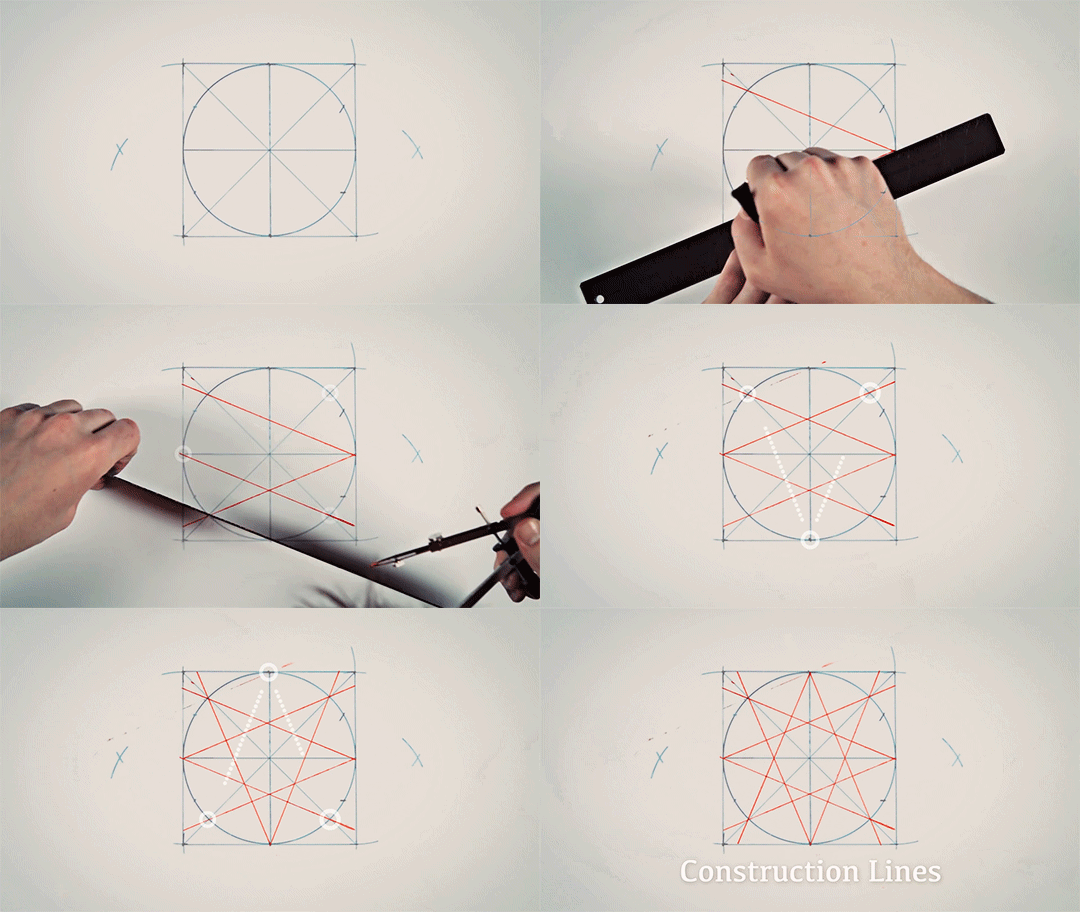
Despite the remarkable complexity of these designs, they can be created with just a compass to draw circles and a ruler to make lines within them, and from these simple tools emerges a kaleidoscope multiplicity of patterns. So how does that work? Well, everything starts with a circle. The first major decision is how will you divide it up? Most patterns split the circle into four, five or six equal sections. And each division gives rise to distinctive patterns.
There’s an easy way to determine whether any pattern is based on fourfold, fivefold, or sixfold symmetry. Most contain stars surrounded by petal shapes. Counting the number of rays on a starburst, or the number of petals around it, tells us what category the pattern falls into. A star with six rays, or surrounded by six petals, belongs in the sixfold category. One with eight petals is part of the fourfold category, and so on.
There’s another secret ingredient in these designs: an underlying grid. Invisible, but essential to every pattern, the grid helps determine the scale of the composition before work begins, keeps the pattern accurate, and facilitates the invention of incredible new patterns. Let’s look at an example of how these elements come together.
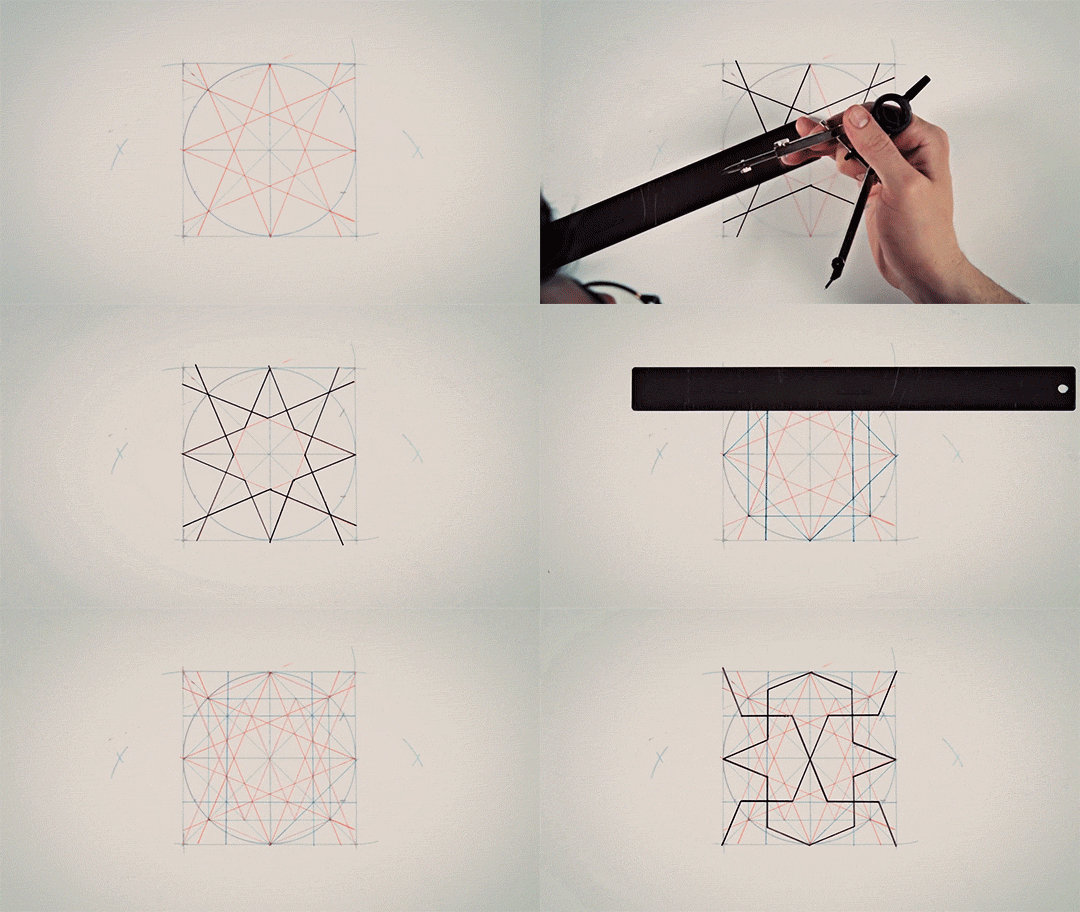
We’ll start with a circle within a square, and divide it into eight equal parts. We can then draw a pair of criss-crossing lines and overlay them with another two. These lines are called construction lines, and by choosing a set of their segments, we’ll form the basis of our repeating pattern.
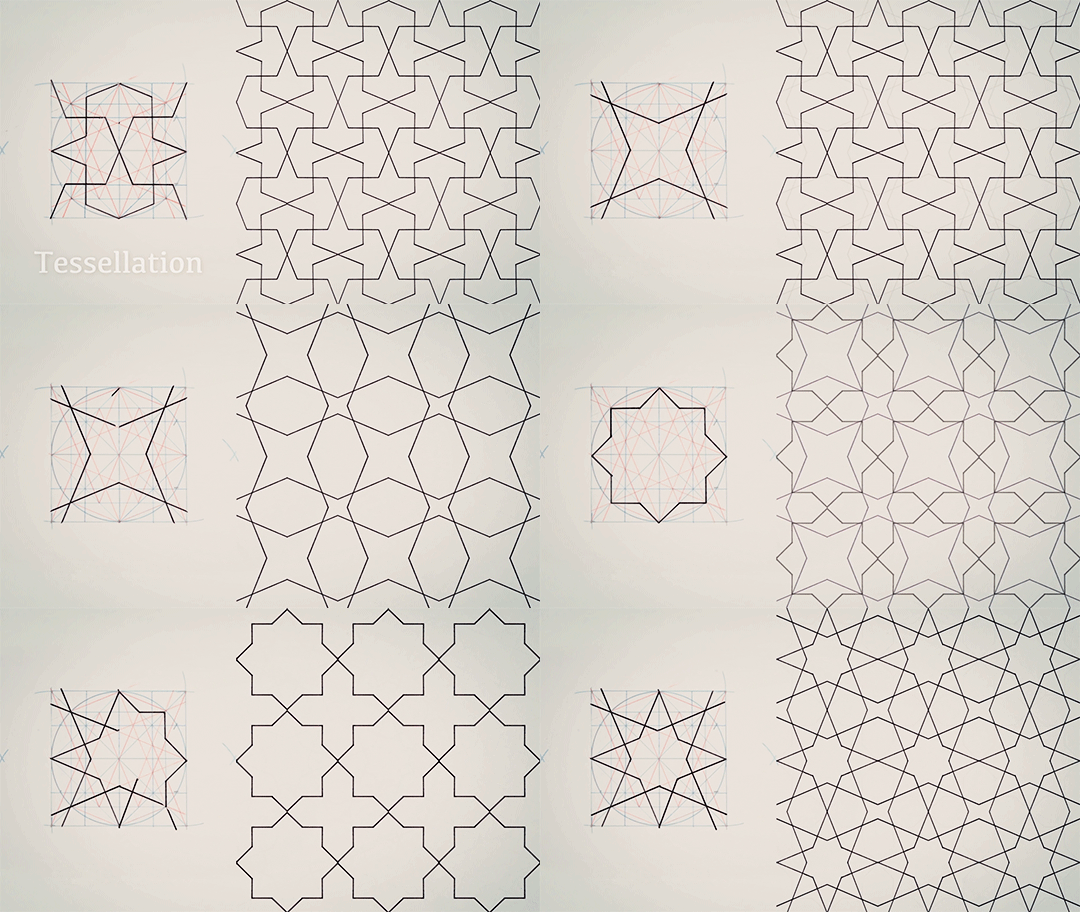
Many different designs are possible from the same construction lines just by picking different segments. And the full pattern finally emerges when we create a grid with many repetitions of this one tile in a process called tessellation.
By choosing a different set of construction lines, we might have created this any of the above patterns. The possibilities are virtually endless.
We can follow the same steps to create sixfold patterns by drawing construction lines over a circle divided into six parts, and then tessellating it, we can make something like the above.
Here’s another sixfold pattern that has appeared across the centuries and all over the Islamic world, including Marrakesh, Agra, Konya and the Alhambra.
Fourfold patterns fit in a square grid, and sixfold patterns in a hexagonal grid.
Fivefold patterns, however, are more challenging to tessellate because pentagons don’t neatly fill a surface, so instead of just creating a pattern in a pentagon, other shapes have to be added to make something that is repeatable, resulting in patterns that may seem confoundingly complex, but are still relatively simple to create.
This more than 1,000-year-old tradition has wielded basic geometry to produce works that are intricate, decorative and pleasing to the eye. And these craftsman prove just how much is possible with some artistic intuition, creativity, dedication along with a great compass and ruler.
I’m re-watching the Prince of Egypt, and the whole God saying “totally, just kill a lamb and paint your door with it’s blood so I know not to kill your first born children” really strikes me as a ruthless Pagan God move…
So my question is… What the fuck?
Some secondary and follow up questions? are:
God sent plagues, but that feels like a lot more work than just saying “Hebrews grab your shit, revolt, and leave, you easily out number the Egyptians.”
God appeared to Moses as a burning bush… Why not something idk, more obviously god-like? He has ultimate power and chose to look like flaming shrubbery.
This story is so weird, because you could change the names of the people and places, then tell me it’s a fantasy story about some Pagan God that wants to deliver his worshippers out of bondage.
But also fuck everyone else who’s having a rough time? He doesn’t care about delivering anyone else, including future enslaved races? Just the Hebrews… That one time… Dude sounds like some choosy guy who has to use a surrogate… Must not have ultimate power if he can’t come down from his high throne and do it himself??
If someone can give me a real solid answer as to why God sounds just exactly like some Pagan Gods (with the lambs blood, water into blood, plagues and shit) then I will shut the fuck up. Until then, imma be questioning this
So these kinds of questions are always amusing from the Jewish perspective, because well…we talk about this all the time. Why bother killing the first borns? Dayenu. (It would have been enough to just let us go free.)
But basically, you’re approaching this from a heavily christian-normative atheist perspective. I don’t think asking Xtians about this story will help, because this is the most fundamentally Jewish story to be tackling.
Here goes:
“totally, just kill a lamb and paint your door with it’s blood so I know not to kill your first born children” really strikes me as a ruthless Pagan God move…
Animal sacrifice absolutely exists in the Torah and during the first and second temple periods. The fact that Judaism explicitly bans all human sacrifice is seen as (in historical context) a huge step away from pagan ritual sacrifice. Many scholars believe the shift to animal sacrifice in general is reflective of understanding man’s more primal urges, and redirecting it away from murder or human sacrifice.
At any rate, the sacrifice of the lamb and painting of the lintel with lamb’s blood could have any number of possible parallels or reasonings.
It’s worth noting that sacrificing a lamb would be considered to be inappropriate by the Egyptians, which is mentioned right there in the text of Exodus. (I assume you didn’t read it):
(Chapter 8) 21 Thereupon, Pharaoh summoned Moses and Aaron, and he said, “Go, sacrifice to your God in the land.” 22 But Moses said, “It is improper to do that, for we will sacrifice the abomination of the Egyptians to God our Lord. Will we sacrifice the deity of the Egyptians before their eyes, and they will not stone us? 23 Let us go [for] a three day journey in the desert and sacrifice to the Lord, our God, as He will say to us.” 24 Pharaoh said, “I will let you go out, and you will sacrifice to the Lord, your God, in the desert, but do not go far away; entreat [Him] on my behalf.”
The Egyptians had Sheep/Ram headed Gods, so it’s not surprising that sacrificing a lamb for God would indicate that the Jewish people are truly not Egyptians, especially if an Egyptian might be inclined to stone someone for doing this.
The choice of sacrificing a sheep might very well be completely intentional as an affront against Egyptian oppressors. We have corroboration historically about the importance of rams and sheep in Egypt:
Herodotus, in his survey of Egyptian customs, writes (Histories, 2:42):
Now all who have a temple set up to the Theban Zeus (=Amun) or who are of the district of Thebes, these, I say, all sacrifice goats and abstain from sheep… the Egyptians make the image of Zeus (=Amun) into the face of a ram… the Thebans then do not sacrifice rams but hold them sacred for this reason.
So this isn’t just a random “pagan” act, this is a group of people intentionally sacrificing an animal held sacred as representative of a pagan god, because that is what God requires and asks for. The Egyptians would never sacrifice a sheep, if the sheep represents some of their deities – but the Hebrews, who do not worship pagan gods, most certainly would.
If you read chapter 9, you will also see Pharaoh try and command that the Hebrews should leave behind their sheep and cattle (in part to prevent their sacrifice) – which they refuse to do.
The “sacrifice” of the lamb fulfills a few different purposes:
it is considered sacrilegious by the Egyptians, thus setting them apart from the pagans (and symbolically showing a willingness to destroy pagan gods)
the lamb is meant to be cooked and prepared so that the families can eat it. It’s a meal to be prepared in light of the fact that they’re preparing to flee.
Torah also tells us the blood is a sign for the Hebrews, and not the Egyptians. The blood is actually marked on the inside of the door (as per Rashi’s commentary on the Hebrew), and therefore the only people who can see the blood would be God (who is able to see all) and the Hebrews from inside their homes. It looks more impressive to do it the other way when you animate it, though.
The verse shows us this:
And the blood will be for you for a sign upon the houses where you will be, and I will see the blood and skip over you, and there will be no plague to destroy [you] when I smite the [people of the] land of Egypt.
Rashi explains: And the blood will be for you for a sign: [The blood will be] for you a sign but not a sign for others. From here, it is derived that they put the blood only on the inside. — [from Mechilta 11]
and I will see the blood: [In fact,] everything is revealed to Him. [Why then does the Torah mention that God will see the blood?] Rather, the Holy One, blessed be He, said, “I will focus My attention to see that you are engaged in My commandments, and I will skip over you.” -[from Mechilta]
Your other questions are also interesting:
God sent plagues, but that feels like a lot more work than just saying “Hebrews grab your shit, revolt, and leave, you easily out number the Egyptians.”
Well, again, have you read a haggadah? We uh, talk about this once a year. If God had let us flee Egypt and not bothered with punishing our oppressors – that would have been enough!
So like, in general, you can’t attend a passover seder without questioning…why God bothered with the plagues.
God appeared to Moses as a burning bush… Why not something idk, more obviously god-like? He has ultimate power and chose to look like flaming shrubbery.
A bush that is on fire but does not get burnt is pretty impressive. But again, I guess you haven’t actually read exodus, because it’s not just a burning bush:
An angel of the Lord appeared to him in a flame of fire from within the thorn bush, and behold, the thorn bush was burning with fire, but the thorn bush was not being consumed.
So Moses said, “Let me turn now and see this great spectacle why does the thorn bush not burn up?”
An angel appears in the fire, the thorn bush is on fire, but does not burn. Then God appears. But eh, maybe that isn’t as wild as you want it to be, so the following exchange between Moses and God is a bit more…miraculous. First God turns Moses’ staff and turns it into a serpent, and back into a staff. This is the first sign Moses can use to prove that God is here. And then…
And the Lord said further to him, “Now put your hand into your bosom,” and he put his hand into his bosom, and he took it out, and behold, his hand was leprous like snow.
And He said, “Put your hand back into your bosom,” and he put his hand back into his bosom, and [when] he took it out of his bosom, it had become again like [the rest of] his flesh.
…you might want to picture it a little bit like this:
– You best start believing in holy stories, Moshe. – you’re in one.
But again, you don’t need to believe in this literally or accept it as literal. But I think it’s a bit silly to say it’s not “miraculous” enough or something.
This story is so weird, because you could change the names of the people and places, then tell me it’s a fantasy story about some Pagan God that wants to deliver his worshippers out of bondage.
Except you couldn’t, which is why it’s a story about the Jewish monotheistic God. If you swapped out the name of God and the people, it would still be a monotheistic story.
You could take “In order that they believe that the Lord, the God of their forefathers, has appeared to you, the God of Abraham, the God of Isaac, and the God of Jacob.“
and instead say “the King, the Ancient One of their forefathers, has appeared to you, the God of Maharba, the God of Caasi, and the God of Bocaj,” but you’re still fundamentally naming a monotheistic deity.
But also fuck everyone else who’s having a rough time? He doesn’t care about delivering anyone else,
Again, this isn’t true, and even PoE illustrates this! Watch it again, and you’ll notice Egyptians dropping their weapons and walking alongside the Hebrews, even crossing the sea! and why else would God give commandments before the Hebrews cross the sea about what to do with the converts and strangers living among them?
Exodus 12:37-38:
The children of Israel journeyed from Rameses to Succoth, about six hundred thousand on foot, the men, besides the young children. And also, a great mixed multitude went up with them, and flocks and cattle, very much livestock.
These are the others, fleeing with the Hebrews. Anyone who wanted to flee was able to do so, and join the Israelites.
including future enslaved races? Just the Hebrews… That one time…
Well there’s a few ways to look at this. But I don’t believe this is an issue of “just this one time.”
1.) the issue of the Jewish people being enslaved and kept from Israel is an issue because if the Jewish people fulfill their end of the covenant (contract) then God should also fulfill their promises. An exodus from slavery in Egypt had to occur for the return to Israel to happen. The covenant is a contract. God is making good on their end of that contract with the exodus.
So here, God intervenes lest they fail to uphold a contract.
2.) But also, ultimately, Judaism promotes the idea that in times of distress mankind should act as if there is no God, and do the right thing. We take action because it is up to us to take that action. It was ultimately up to the Israelites to leave Egypt, even if God made it seem more possible to do so. It was up to the Israelites to pack their things and prepare their rations and even up to them to bravely step forwards into the sea and keep going, even though it took time for the waters to part. (Some say the waters did not part until the Israelites were so far into the water that it would have drowned them.)
So have other people been liberated from slavery? Absolutely. You have two choices – you can say it was because of “God” or you can say it was because of the hard work of abolitionists and slave uprisings. It’s not a mystery why the African American community references Exodus so heavily in gospel music – Jewish freedom is a template for all freedom (and anyways, there are also black Jews!). So did God free black slaves, or did black men and women and abolitionist allies work tirelessly for that freedom? Couldn’t it be both? Shouldn’t we say, be capable of going “If God freed us then, then now our lives should be also dedicated to freeing everyone else?” Why would you assume mankind is free from the work of liberation? It is our job to work for freedom on behalf of others, not to just sit on our ass and expect God to do the work.
Again, no surprise that Jewish Americans were involved in abolitionism throughout the world and heavily involved in the US civil rights movements.
Dude sounds like some choosy guy who has to use a surrogate… Must not have ultimate power if he can’t come down from his high throne and do it himself??
…Choosy, absolutely. Not having ultimate power is endlessly debatable. One way or another, it happened, and certainly God sent down the forces to do so in Exodus. But also, uh, you realize a lot of this was a learning and teaching process, right?
If someone can give me a real solid answer as to why God sounds just exactly like some Pagan Gods (with the lambs blood, water into blood, plagues and shit) then I will shut the fuck up. Until then, imma be questioning this
Like I said, lamb’s blood is in direct contrast/opposition to local Pagan worship.
The Nile running red with blood is actually deeply symbolic – recall that in the beginning of the Exodus story, the first born Hebrew sons are being thrown into the Nile River. So what God is doing is illustrating the fact that the Nile was filled with the blood of the Hebrew people – specifically their firstborn sons – and this is the blood which Pharaoh was responsible for shedding. It’s similar to Macbeth, when Lady Macbeth hallucinates blood on her hands after her murderous act. Except here, the entire Nile turns to blood, haunting Pharaoh with the blood of the slaves his father had murdered. Talk about facing the reality of your actions. This is where the blood comes from.
Either way, none of these things make God more or less pagan? The issue of paganism is not how a God acts or behaves, but whether or not there are other Gods. Like that’s literally it. Hope that helped? Lmao. These questions aren’t that weird.
Shoot son, you sure rose to that challenge!
Ngl, you schooled me. Historical context was missing in the movie, so you’ll have to give me that one. The rest of that I never fucking learned in years of Sunday school, (and these kind of questions weren’t encouraged.) Thank you, @keshetchai I’ve learned a lot today!
Forgive me that I remain skeptical, it still boils down to having faith or not having faith; this isn’t a reflection of you though and thank you again for such a thorough answer 🙂
no problem! This is a big example of the massive differences between Judaism and xtianity as a whole. A lot of the questions you touched upon are built in to the passover seder, and are encouraged. We ask exactly a lot of these things!
There’s also a part of the seder where we discuss the four questions (why is this night different from all other nights?) and then we discuss the Four Children, each child covering a different attitude towards the story. To paraphrase:
The Wise Child asks: What does this all mean? What are the laws we are commanded, the customs and traditions we uphold?
The Wicked Child*** asks: What does this mean to you? [Why do you even bother with all this?] ***wicked isn’t like, “evil” it’s more like “challenging.” or “isolated” from the community by distancing themselves.
The Simple Child asks: What is it that we’re doing? What’s the seder about?
The Child Who Does Not Know How to Ask doesn’t ask a question at all, and instead can be prompted into thinking of questions to ask, being helped to understand things, or may just be too young to formulate the question– and yet we still must include them.
Each “type” of question is meant to be met with an answer. So asking these questions might be discouraged in xtianity, but is part of the Jewish tradition.
It’s okay if you don’t believe everything, or don’t take it literally. Honestly, that isn’t why I answered your questions – I’m not concerned about convincing you of the truth or literalism of the story. I just think it’s fair to want honest answers to interesting questions. Personally, whether or not it happened literally isn’t really a big deal for me, or even where i derive meaning when hearing the story. Faith means something different in Judaism than it does in xtianity, so I don’t have any kind of investment in trying to convince you to “just believe” because someone said so.
if you don’t want to believe in parts or all of it, it’s no skin off my nose. Frankly, I’m way more concerned with impressing the idea that “slavery is bad and we as people are obligated to help in the liberation of others.” 🙂 the times when these questions become an issue are when gentiles present the questions as if Jewish people are stupid/backwards/barbaric/etc. That would be an issue, but asking “what the hell was going on there??” earnestly isn’t.
Reblogging because:
(a) this is an excellent and thoughtful discussion of various theological issues;
(b) I really appreciate people doing what @keshetchai does here, giving questions serious, thorough, and kind answers;
(d) this is just a super sweet exchange all round; and
(e) I learned things from it! (I did not realize about the blood being on the inside of the doors, or about other Egyptians joining the Israelites in their flight.)
This is such a fascinating bit of theological/historical discussion, in which I learned stuff I didn’t know about Judaism, Passover, and Exodus! And now I’m here as a lapsed Catholic to raise the level of discourse with an Eddie Izzard routine about Christianity that it reminded me of:
“I said ‘Drink this wine, it is my blood–’“ “You said what?” “… I said ‘Drink this wine, it is my blood,’ I was trying to make a ceremony–” “But that’s, that’s vampirism! Vampiric thing, ‘drink my blood,’ you’ve got pagan things right there on day one of the new religion!” “… Oh, sorry.” “Why didn’t you just say ‘Drink this wine, it’s a merlot’?”











Dude sounds like some choosy guy who has to use a surrogate… Must not have ultimate power if he can’t come down from his high throne and do it himself??


 lanablack