
I think this is necessary to post. I see a lot of people “saving” bunnies.
“*Bunnies are one of the most frequently “kidnapped” mammal species.
*Mothers dig a very shallow nest in the ground that is easily uncovered when mowing or raking the yard. If you find a rabbit nest-leave it alone!!
*Mother rabbits only return to the nest two or three times a day, usually before dawn and right after dusk.
*To determine if they are orphaned, either place a string across the nest in a tic-tac-toe shape or circle the nest with flour. Check the nest the next day. If the string or flour is disturbed, the mother has returned. If not, take the bunnies to a rehabilitator.
* A bunny that is bright eyed and 4-5 inches long is fully independent and does NOT need to be rescued!
*If you find a bunny that does need to be rescued, put it in a dark, quiet location. Bunnies are a prey species and while they may look calm, they are actually very, very scared!”Never knew this, keeping this for reference
As a student of Veterinary Medicine I can completely confirm this! Do NOT take them out of their nest unless you’re 100% sure that the mother did not come back for them after at least one day!
Tag: useful stuffs
what really matters
I DID NOT KNOW THIS WEBSITE EXISTED OH MY GOODNESS
A collection of Ways to Tie a Necktie
Our other collections:
spine cosplayers take note
i know like six of these by memory so i don’t want anyone ever to tell me”that’s not how you tie a tie” ever again just don’t do it i know what im doing when it comes to ties so shut the fuck up why do you always assume that i don’t know what im doing I KNOW WHAT IM DOING SHUT THE FUCK UP
Friendly reminder that with one click, you can:
- Give free food to the hungry.
- Help get a woman in need get a free mammogram.
- Give free food to shelter animals.
- Give a free meal to a homeless and hungry veteran.
- Help a family receive therapy for an autistic family member.
- Help provide a child with life-saving health care.
- Help give a child a free book to read.
- Protect 11.4 square feet of wildlife habitat.
Stuff to do on your day off.
Filtering AO3 search results
I thought I might share this handy trick I picked up from an article on AO3 that I use daily: filtering out fandoms, characters and pairings I don’t want to see in my search results.
Tags from those three categories have id numbers, which you can easily find out by going to the tag page and mousing over the RSS feed button; the id number is in the link. Then you can filter them out using the “filter_ids” switch.
So, for instance, if I’m browsing the “Bruce Wayne” tag, and I don’t want to see results for works in the Nolanverse fandom or works that include the Batman/Joker pairing, here’s what I’ll do:
- First, I go to the tag page itself.
- Inevitably, works from both of those tags will be on the first page, so I’ll open those tag pages in new tabs.
- I’ll mouse over the “Subscribe to the feed” button on the pages of the tags I don’t want, and note down the numbers from the link. In this case they’re, 747714 and 30815.
- Now that I have the id numbers, I’ll go back to my “Bruce Wayne” tag page, and under “Search within results”, I’ll simply filter out the ones I don’t want to show up by typing
- -filter_ids:30815 -filter_ids:747714
- After I hit enter, I have the Bruce tag without any works involving Nolan and Joker.
You can add as many id numbers as you want, just remember to add a minus sign before each.
-filter_ids:And to make things easier, bookmark your new shiny tag with the results filtered, so you don’t have to do it again. Some stuff might creep through, if it isn’t properly tagged, but generally this works very well.
TA DA
How to, like, write cover letters and resumes and know what jobs to apply to and shit.
Basically I have been blessed to be close to people who work in hiring and were very, very willing to pass along their knowledge and tips and since a lot of people I know on here seem mystified by these things, I will share my vast wealth of knowledge with you*
*Some of this knowledge might be contradicted by specifics from your own field. If you’re a chemical engineer some of these things might not apply and that’s fine. This is just ~*widely applicable*~ stuff.
Cover Letters
Cover letters are the stupidest part of a job application. The cover letter is really only there to show two things: 1) That you have a command of language that is both accurate and appropriate; 2) you read the job listing.
- Your cover letter should be short. The hirer has likely read hundreds that day, and by read, I mean “skimmed over lightly.” You don’t need to fill up an entire page.
- It should only contain pertinent information. Do not try to be cutesy or “creative” unless the job listing SPECIFICALLY asks for that. Trust me, I’ve had to hire people. Those people’s letters got passed around for mocking. DO NOT BE THAT PERSON.
- It should speak to the job listing, but only enough that it shows that you read it. If the job listing emphasizes that they’re looking for somebody who is willing to work odd hours, throw in a line that in your past experience you have been noted for being flexible with time. It doesn’t need a Faulkner-length explanation.
- If you know the name of the person to whom the letter is addressed, address it to them. If you it is a blind application, you don’t need to put “To Whom It May Concern” or “Dear Sir/Madam;” just don’t say anything.
- Stop freaking out about it. Seriously, your CL is not nearly as scary as you think it is. If you want to see a screenshot if an example cover letter that is a “catch all,” click here. I just pulled this out of my ass for a fictional job/person.
Resumes
Your resume is not an “employment record.” Unless you have no experience, it should only list the things that are the most impressive or demonstrate your abilities the clearest.
- If you have an “Objective” on your resume, take it off. All of the employers I know said, “We KNOW your objective—you want the job! It just takes up space.”
- Always make sure that your resume is formatted cleanly and with maximum readability in mind. I strongly, strongly suggest visiting this link to see how to format your resume best. Visual cleanliness matters.
- Your resume should be ONE page. Just one. Not two or more.
- You can’t lie on your resume; you can learn how to make things sound more impressive. If you worked at a hair salon cleaning up, don’t say “Swept floors.” Instead write, “Contributed to the efficiency and cleanliness of the salon by sweeping floors.” It sounds like bullshit to you, but to a prospective employer, it sounds like you’re happy being part of a team. Try to describe what you did in at least 7 words.
- You can divide your resume if you want to highlight certain experiences over others. Making two sections such as “Relevant Experience” and “Other Experience” breaks it up, allows the reader to skip around, and let’s you highlight what you want to highlight.
- Learn to weed things out. Unless you can make it look like it taught you something huge, don’t waste the space. At the same time, if a job sucked but you can make it appear like it really impacted you, use it. This is not the truth about how you felt about that last job. This is you advertising yourself. You’re trying to get a job, not a Nobel Prize for emotional honesty.
Now, what about the Skills section? You should have one, but as one friend said, “Nobody gives a shit if you went to France and had a great time. What we care about is if you’re proficient in French.” That should be your metric for things:
- Only list experiences that would aid you in this job or a similar one—not things that were “cool.” This is the place for things that you’ve learned but perhaps can’t tie to a job. Examples: foreign language skills, clerical training, courses/certifications, etc.
- List all of the software that you know. Even if it doesn’t seem relevant to that job, weird things happen. List any MS Office/equivalent software, if you are familiar with both Mac and PC, any graphics editing software you know…
- SOCIAL MEDIA IS A THING THAT YOU SHOULD DEFINITELY MAKE KNOWN. To people ~30 and under, social media seems like a given. But to many employers, it’s a mystical world filled with equal amounts of marketing opportunities and terror. Make it clear what social networking sites you know how to use—obviously Facebook and Twitter, but also LinkedIn, Pinterest, Tumblr, etc.
Applying to Jobs/Interviewing
Unfortunately, I can give you less specific advice here because we are not likely working in the same field—but here are just some general things to file away:
- If there’s a job listing that you feel qualified for but the listing says it wants more years of experience than you have, apply anyway. Those employers are unlikely to find that unicorn that has 4+ years of experience and is willing to work basically minimum wage. While more experience is a plus, they really just want somebody who can do the job. When it comes to applying to jobs, you really have nothing to lose by applying to anything that tickles your fancy.
- Interviewing is an entire post unto itself, but I’ll give you the tips that I’ve been given by my people: be calm, be on time, and ask good questions. Always have some questions lined up, even if you already know the answer. “What are you looking for in the right candidate?” is a good example, or “Are there opportunities for growth within the company?” etc.
Accepting a Job
So you got a job offer; exciting! Before you immediately accept, really vet the place to make sure it’s somewhere you’d like to work. Months of unemployment make you desperate, but sometimes jumping at the first opportunity it isn’t worth it. THIS HAPPENED TO ME, LEARN FROM MY MISTAKES.
Things you should think about:
- Do I know ALL things about the job, including: what I will be paid/how often, if there are benefits and when I get them, what hours I am working, how overtime is handled, how sick time is handled, etc. These are all incredibly important to know and if your employer is legitimate they will welcome you asking them.
- Is the distance commutable, or is it too far from home? (Think about how transit/gasoline will cut into your paycheck.)
- Does the job give me the time necessary to do other important things?
- Does the office environment seem like one I can spend at least six months in? (Every month at a bad job feels like an eternity—if you have bad feelings, trust them.)
- Does the job offer me anything besides a paycheck? Will I be learning any skills at this job or making important connections that can help me down the road?
IMPORTANT: If an employer tries to give you a W-9 tax form upon your hiring and you are NOT a freelancer (independent contractor), RUN. This is tax fraud and is very messy and is entirely there to screw you. Become familiar with the legal definition of a freelancer so you know if you’re walking into a shady place. It happens more than you’d think, and it sucks, and is weird.If you have any questions, feel free to send me a message or whatever, I’ll gladly answer to the best of my ability! GO GET ‘EM.Vital information for your everyday life.
since somebody asked for my brush settings, here they are! these are the brushes I favor 95% of the time unless I have to use Photoshop for something
there are kind of a lot ahaha sorry
they’re really nothing special, and I’m often changing certain things depending on my needs, but I’m happy to share the settings I’m currently using anyway c:
everything else is either completely default or doesn’t get used often
just keep in mind these aren’t necessarily set in concrete so I encourage you to play around until they suit your own style
(these also look best in high resolutions!)
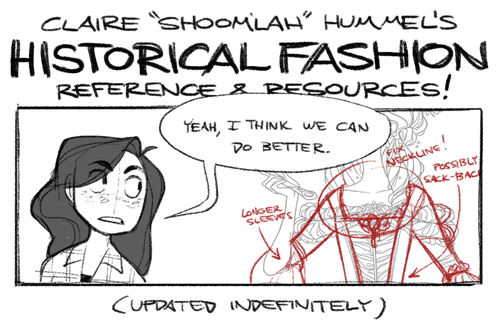
Claire’s fancy-pants HISTORICAL FASHION MASTER POST
So my historical costuming resources list from 2011 was less than a page long- I’m not saying that I’ve learned a lot in the past three years, but this list is now sitting pretty at a solid nine pages. Whew. And people wonder why I want to redo this damn series.
This list is by no means an exhaustive one- it’s a list of (primarily western) historical fashion resources, both online and offline, that is limited to what I know, own, or use! It’s a work in progress, and I’m definitely hoping to expand on it as my knowledge base grows. First things first, how about a little:
ADVICE FOR RESEARCHING HISTORICAL FASHION
- Read, and read about more than just costuming. Allowing yourself to understand the cultural and historical context surrounding the clothing of a particular region/period can be invaluable in sussing out good costume design. Looking at pictures is all well and good, but reading about societal pressures, about construction techniques, daily routines, local symbolism, whatever else will really help you understand the rhyme and reason behind costuming from any given context.
- Expand your costume vocabulary. When you’re delving into a new topic, costuming or otherwise, picking up new terminology is essential to proper understanding and furthering your research. Write down or take note of terms as you come across them- google them, look up synonyms, and use those words as a jumping off point for more research. What’s a wire rebato? How does it differ from a supportasse? Inquiring minds want to know.
- Double-check your sources. Especially on the internet, and double especially on tumblr. I love it, but it’s ground zero for rapidly spreading misinformation. Books are usually your safest bet, but also take into account their date of publication, who’s writing them- an author’s biases can severely mangle their original source material.
- Don’t be afraid to ask for help. Do everything you can to find out information on your own, but feel free to reach out to people with more specialized areas of knowledge for help! Be considerate about it- the people you’re asking are busy as well- but a specific line of questioning that proves you’re passionate and that you respect their subject matter expertise can work wonders.
Okay, onto the links!
It’s impossible to overstate the importance of getting off the internet and looking into books! God bless the internet, but books are (generally, this isn’t a rule) better-researched and better-sourced. Bibliographies also mean each individual books can be a jumping off point for further research, which is always a fantastic thing.
Remember- owning books is awesome and you should absolutely assemble your own library of resources, but LIBRARIES. Libraries. You’ll be surprised to find what books are available to you at your local library.
GENERAL / SURVEYS
- British Costume from Earliest Times to 1820
Fine book with lots of first hand sources, but be wary of the photography in the book- reproduction costumes and thus somewhat less reliable. Though hilarious.- Corsets and Crinolines
Norah Waugh’s invaluable survey of corsetry and corset patterns- used the world ‘round by modern corsetieres.- Costume in Detail: Women’s Dress 1730-1930
Elaborate line drawings/diagrams of extant period garments! A fantastic survey.- Cut of Men’s Clothes
PDF available online! Patterns for men’s period garments.- Cut of Women’s Clothes
Patterns for women’s period garments.- Greenwood Encyclopedia of Clothing Through World History
This is a library find, unless you have a pretty three hundred bucks lying around- a great, general resource.- A History of Costume
A lot of good text and info, to be taken with a grain of salt. Be wary of any reconstructions and or “supposed” patterns that aren’t directly based on extant garments or firsthand accounts.- Fashion (Taschen 25th Anniversary)
A survey of the Kyoto Costume Institute’s fashion collection- broad but beautiful. On every fashion student’s bookcase.- Fashion: The Definitive History of Costume and Style
Great overview of fashion history from the Smithsonian and DK publishing.- The History of Costume: From the Ancient Mesopotamians Through the Twentieth Century
Broad costume survey, second edition.
- What People Wore: 1,800 Illustrations from Ancient Times to the Early Twentieth Century
this is one of those “I am putting this here because I used it a ton when I was younger” but man, mixed bag. Really cool survey to browse through, but also work that is a copy-of-a-copy-of-a-copy in most instances and thus not necessarily trustworthy as a resource.
- What People Wore When: A Complete Illustrated History of Costume from Ancient Times to the Nineteenth Century for Every Level of Society
A collection of Racinet and Hottentoth’s costume plates from the 19th century. A beautiful survey but, since these are later illustrations, to be taken with a grain of salt.Patterns fo Fashion books
Detailed, hand-drawn diagrams of historical fashion, inside and out. Pretty amazing stuff.
- Patterns of Fashion: The Cut and Construction of Clothes for Men and Women, C.1560-1620
- Patterns of Fashion 1: Englishwomen’s Dresses & Their Construction C. 1660-1860
- Patterns of Fashion 2: Englishwomen’s Dresses & Their Construction C. 1860-1940
- Patterns of Fashion 4: The Cut and Construction of Linen Shirts, Smocks, Neckwear, Headwear and Accessories for Men and Women C. 1540-1660
Fashion in Detail books
Not what you want if you’re looking for photos of entire costumes- note the “in detail” bit up there. Just a beautiful series, and great reference for all the little things you might miss otherwise. The V&A has an amazing fashion collection, and it’s great to see them share it with the world.
- Nineteenth Century Fashion in Detail
- Seventeenth and Eighteenth-Century Fashion in Detail
- Underwear: Fashion in Detail
- World Dress: Fashion in Detail
The one non-western entry in the series.
- Fashioning Fashion: European Dress in Detail, 1700 – 1915
LACMA’s response to the V&A’s series mentioned above, also an invaluable resource for historical fashion detail.

 lanablack