becausedragonage:

freshest-tittymilk:

princealigorna:

And this is why we used to make cars out of STEEL instead of FIBERGLASS! Sure, fiberglass is a lot lighter in weight and hence a hell of a lot better for gas mileage. But you hit anything at more than 20 mph and the entire body explodes off the fucking thing, and now you’re spending more to repair the car than it’s worth because you need a entire front end, read end, or side panel. They can’t just take the damaged section off, beat it out with a hammer, sand it, and repaint it.

Everything is made with the idea of it being easier to replace than to maintain, aka planned obsolescence. Thanks, capitalism

You guys are obscenely, dangerously wrong. 

It’s not planned obsolescence, it’s physics.

Modern cars crumple to absorb and distribute the forces of impact in an accident in an effort to protect the occupants. When cars didn’t have those crumple zones, the occupants, being the soft, squishy things they were, took those forces and were mangled or killed in horrible ways. Also, those older cars took hidden damage that often went unnoticed and made them very dangerous to drive. IT’s really easy to hide a twisted frame when all you need to do to make the car look okay is a bit of sanding and paint.

I recently watched a TV show where a small sedan was run over by the trailer of an eighteen-wheeler. Run. Over. They had to unwrap the crumpled ball of a car from the undercarriage of that trailer. Guess what? The driver suffered only minor injuries because the car collapsed in exactly the way it was designed to so that she, in the very strong frame surrounding the passenger compartment, was protected. 

And no, don’t thank capitalism for these modern cars. Thank Ralph Nader and countless other safety activists who worked tirelessly to make car manufacturers accountable for the safety of the people who drove their cars. 

thesylverlining:

infernalpume:

darkfrog24:

schizoauthoress:

Today I learned that Van Halen have that rider in their contract about “a bowl of M&Ms with all the brown ones removed” in order to know at a glance if the promoter read the entire contract.  And the reason they do THAT is because they once had a stage collapse because a promoter hadn’t read the proper way to set up all the specific technical stuff.

So if the band goes in the dressing room or catering and sees brown M&Ms, they know they have to double-check the stage setup for safety.

I heard about this on Freakonomics Radio.  Turns out the bit about no brown M&Ms is HUGE, in BIG font, bold, underlined and quotated like they’re on the Group W Bench.

The band was all, “We have fifty-pound lights hanging over our heads and fire being shot out of cannons.  We had to know whether they read our safety regs so we didn’t flamebroil any roadies.”

interesting how this has become a meme in the music industry about divas. i’ve always heard jokes that amount to “this stuck up celebrity hates the green gummy bears!! they’re refusing to perform just for that???” and its reading stuff like this that i realise how that joke might have come about. people get grumpy that the band refuses to play but cant admit its because THEY’RE incompetent, so they make it all about the M&Ms. another example of artists using a creative method to ensure they have a perfectly reasonable request fulfilled that is then bastardised by lazy people who wanna make money off them. 

…this is like the music industry version of hearing the truth behind the McDonalds hot coffee lawsuit

rassoey:

avianawareness:

aph-romania:

reallymisscoffee:

dansknapp:

stultiloquentia:

doctormemelordmd:

fangirling-so-hard-rn:

Crows are scary
They

  • use tools
  • Can be taught to speak (like parrots)
  • Have huge brains for birds
  • like seriously their brain-to-body size ratio is equal to that of a chimpanzee
  • They vocalize anger, sadness, or happiness in response to things
  • they are scary smart at solving puzzles
  • some crows stay with their mates until one of them dies
  • they can remember faces
  • SIDENOTE HERE BECAUSE HOLY SHIT.  They did an experiment where these guys wore masks and some of them fucked with crows.  Pretty soon the crows recognized the masks = douchebag.  But the nice guys with masks they left alone.  THEN, OH WE’RE NOT DONE, NO SIR crows that WEREN’T EVEN IN THE EXPERIMENT AND NEVER SAW THE MASK BEFORE knew about mask-dudes and attacked them on sight.  THEY PASSED ON THE FUCKING INFORMATION TO THEIR CROW BUDDIES.
  • They remember places where crows were killed by farmers and change their migration patterns.

Guys I’m really scared of crows now.
(q

Yeah but have you seen this 

A colleague of my dad’s lives next to a lake, and looked out the window one morning to see a duck trapped in the ice. A crow swooped down. “Oh hell,” she thought, expecting carnage, because crows are opportunists. But the crow chipped at the ice with its beak until the duck was free.

Idk of this counts but a few crows saved me from a magpie swooping attack once ,they’re bros who can tell when magpies are being unreasonable and need to chill

I love crows so damn much. When I was fifteen, I hit a pretty serious bout of depression, to the point I was in my room for months. Well, a family of crows made a nest in a tree outside my window. There were two parents and two chicks. One chick was healthy and strong. One was weak, and had a caw like something being strained. It sounded more like a rooster crowing and so my parents jokingly named him ‘Buck’.Well… months passed and Buck’s sibling was taught to fly. His parents focused on the sibling because the sibling was strong. The father stayed behind to try and teach Buck, but I saw him try to fly, fail, and crash to the floor. His father helped him back up into the tree.

Every day, I would watch Buck from my window until one day I opened it and started talking to him. He was small and gangly and he couldn’t caw right. His feathers were all over the place and I felt a kinship. So I made a deal with him. I told him that if he could do it, if he could fly, then I could find the strength to get up. Well… near the end of the season, after talking with him every day, I finally saw him get out of the nest. He went to the edge of his branch, braced himself, and jumped… and just before he hit the ground, he soared back up into the sky. I cheered harder than I ever had before.

That winter, Buck left the area. I was crestfallen. I felt like I’d lost a friend. But I was so damn proud of him. 

Cut to the next spring? I’m walking up the driveway one day when suddenly I hear a sound… a broken caw. I look up, and Buck is sitting in a tree above my head. He stared at me and puffed his feathers, then hopped down in front of me and cawed again. I was so damn thrilled, and I told him how proud I was of him. He ruffled his feathers and then soared off into his old tree. 

That summer? I heard two broken caws. One from Buck… and one from his chick.

Cut to ten years later? We have a family of crows who all have a very distinct caw and they come here and spend every spring, summer, and fall on our property. Buck still greets me every spring.

that last reply made me wanna cry. that’s so beautiful.

Don’t forget the Russian Crow SLEDDING DOWN A ROOF not once, but twice. 

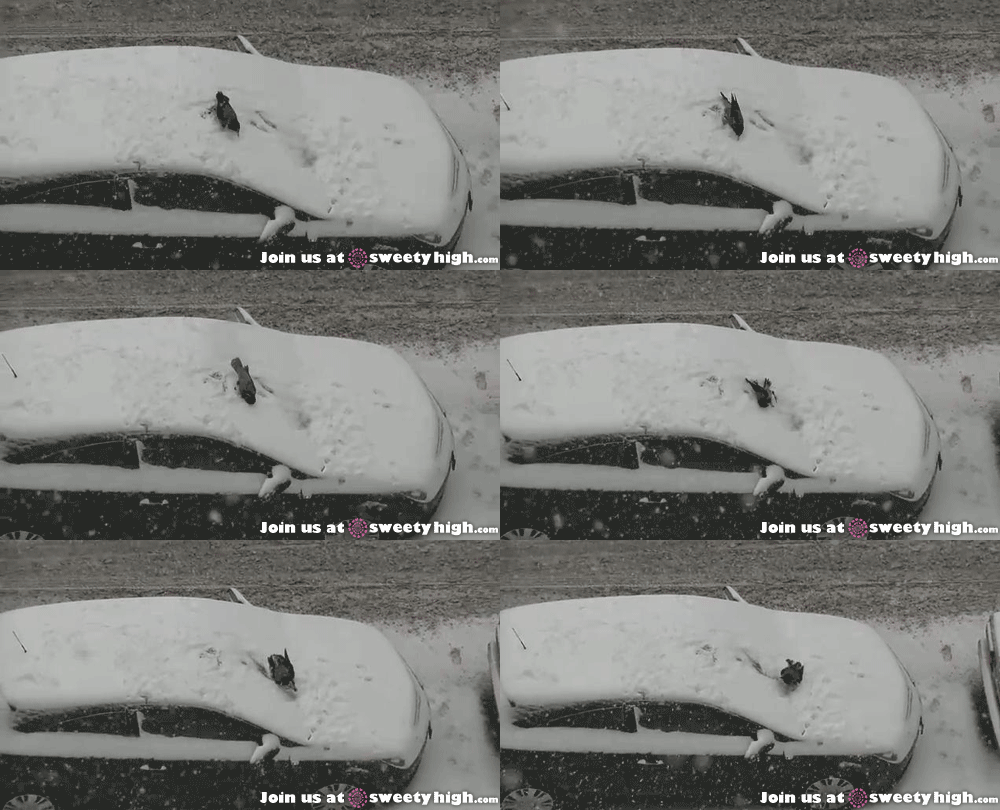
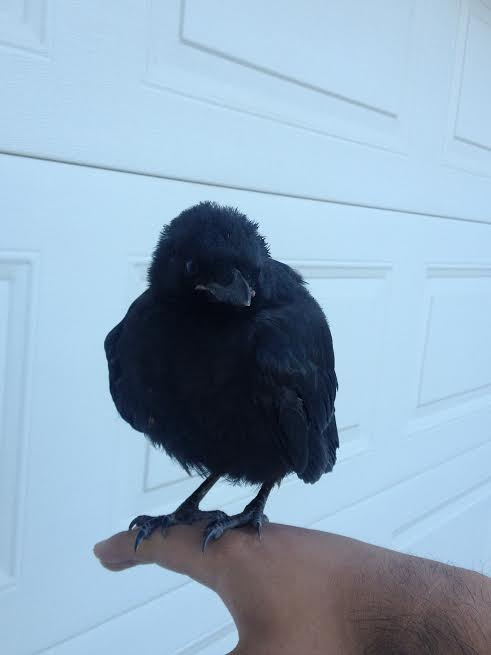
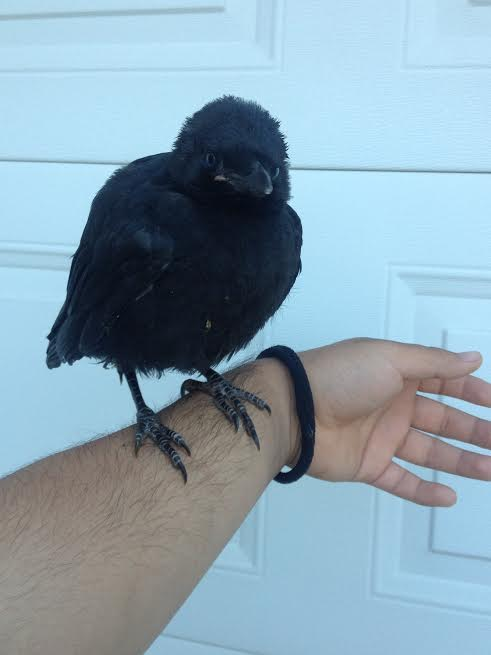
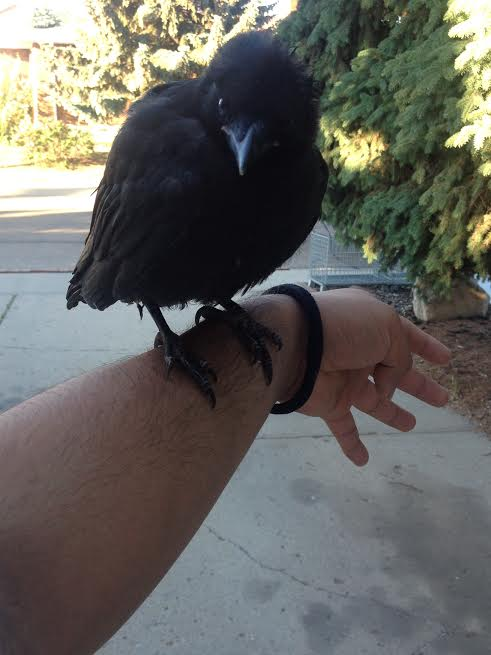
this one morning i kept hearing really loud caws, i remember it was like 5am, LIKE REALLY LOUD AND ANNOYING AND AGGRESSIVE, so loud that i could hear it through a closed window, and i eventually went outside to check it out. there was a crow on my front lawn, it had an injury on its head and couldn’t fly and there were two other crows circling right above it, and they were cawing like mad. 

i tried to get close and take a better look and one of them dived super low and tried to attack me. so i went back in the house and chopped some sliced raw meat and tossed it at him from a distance.

a few more times later, very soon after, they could tell i was trying to help, and did not attack me. i was “allowed” to walk up close and pick him up, he couldn’t drink water properly so i had to dip my finger in a bowl and stick it in his mouth.

i did this few times a day and it went on for about a week before he disappeared, i thought he recovered and left, but he came back the next day and lands on me, and i see him around the block quite often, and he would come sit on my shoulder for a few minutes and then fly away again. i feel like i’ve adopted a son.

image
image
image

Personality; not just for humans

elodieunderglass:

lenyberry:

the-tabularium:

fozmeadows:

wolveswolves:

We usually see “elephants”—or “wolves” or “killer whales” or “chimps” or
“ravens” and so on—as interchangeable representatives of their kind.
But the instant we focus on individuals, we see an elephant named Echo
with exceptional leadership qualities; we see wolf 755 struggling to
survive the death of his mate and exile from his family; we see a lost
and lonely killer whale named Luna who is humorous and stunningly
gentle. We see individuality. It’s a fact of life. And it runs deep.
Very deep.

Individuality
is the frontier of understanding non-human animals. But for decades, the
idea was forbidden territory. Scientists who stepped out of bounds
faced withering scorn from colleagues. Jane Goodall experienced just
that. After her first studies of chimpanzees, she enrolled as a doctoral
student at Cambridge. There, as she later recalled in National
Geographic, “It was a bit shocking to be told I’d done everything wrong.
Everything. I shouldn’t have given them names. I couldn’t talk about
their personalities, their minds or their feelings.” The orthodoxy was:
those qualities are unique to humans.

But these
decades later we are realizing that Goodall was right; humans are not
unique in having personalities, minds and feelings. And if she’d given
the chimpanzees numbers instead of names?—their individual personalities
would still have shined.

“If ever there
was a perfect wolf,” says Yellowstone biologist Rick McIntyre, “It was
Twenty-one. He was like a fictional character. But real.” McIntyre has watched free-living wolves for
more hours than anyone, ever.

Even from a
distance Twenty-one’s big-shouldered profile was recognizable. Utterly
fearless in defense of his family, Twenty-one had the size, strength,
and agility to win against overwhelming odds. “On two occasions, I saw
Twenty-one take on six attacking wolves—and rout them all,” Rick says.
“Watching him felt like seeing something that looked supernatural. Like
watching a Bruce Lee movie. I’d be thinking, ‘A wolf can’t do what I am
watching this wolf do.’” Watching Twenty-one, Rick elaborates, “was like
watching Muhammad Ali or Michael Jordan—a one-of-a-kind talent outside
of ‘normal.’”

Twenty-one was a
superwolf. Uniquely, he never lost a fight and he never killed any
defeated opponent. And yet Twenty-one was “remarkably gentle” with the
members of his pack. Immediately after making a kill he would often walk
away and nap, allowing family members who’d had nothing to do with the
hunt eat their fill.

One
of Twenty-one’s favorite things was to wrestle little pups. “And what
he really loved to do,” Rick adds, “was pretend to lose. He just got a
huge kick out of it.” Here was this great big male wolf. And he’d let
some little wolf jump on him and bite his fur. “He’d just fall on his
back with his paws in the air,” Rick half-mimes. “And the
triumphant-looking little one would be standing over him with his tail
wagging.

“The ability to
pretend,” Rick adds, “shows that you understand how your actions are
perceived by others. I’m sure the pups knew what was going on, but it
was a way for them to learn how it feels to conquer something much
bigger than you. And that kind of confidence is what wolves need every
day of their hunting lives.”

In Twenty-one’s
life, there was a particular male, a sort of roving Casanova, a
continual annoyance. He was strikingly good-looking, had a big
personality, and was always doing something interesting. “The best
single word is ‘charisma,’” says Rick. “Female wolves were happy to mate
with him. People absolutely loved him. Women would take one look at
him—they didn’t want you to say anything bad about him. His
irresponsibility and infidelity; it didn’t matter.”

One day,
Twenty-one discovered this Casanova among his daughters. Twenty-one ran
in, caught him, biting and pinning him to the ground. Other pack members
piled in, beating Casanova up. “Casanova was also big,” Rick says, “but
he was a bad fighter.” Now he was totally overwhelmed; the pack was
finally killing him.

“Suddenly
Twenty-one steps back. Everything stops. The pack members are looking at
Twenty-one as if saying, ‘Why has Dad stopped?’” The Casanova wolf
jumped up and—as always—ran away.

After
Twenty-one’s death, Casanova briefly became the Druid pack’s alpha male.
But, Rick recalled: “He doesn’t know what to do, just not a leader
personality.” And although it’s very rare, his year-younger brother
deposed him. “His brother had a much more natural alpha personality.”
Casanova didn’t mind; it meant he was free to wander and meet other
females. Eventually Casanova and several young Druid males met some
females and they all formed the Blacktail pack. “With them,” Rick
remembers, “he finally became the model of a responsible alpha male and a
great father.”

The personality of a wolf ‘matriarch’ also helps shape the
whole pack. Wolf Seven was the dominant female in her pack. But you
could watch Seven for days and say, ‘I think she’s in charge,’ because
she led subtly, by example. Wolf Forty, totally different; she led with
an iron fist. Exceptionally aggressive, Forty had done something unheard
of: actually deposed her own mother.

For three
years, Forty ruled the Druid pack tyrannically. A pack member who stared
a moment too long would find herself slammed to the ground, Forty’s
bared canines poised above her neck. Yellowstone research director Doug
Smith recalls, “Throughout her life she was fiercely committed to always
having the upper hand, far more so than any other wolf we’ve observed.”
Forty heaped her worst abuse on her same-age sister. Because this sister
lived under Forty’s brutal oppression, she earned the name Cinderella.

One year
Cinderella split from the main pack and dug a den to give birth. Shortly
after she finished the den, her sister arrived and delivered one of her
infamous beatings. Cinderella just took it, as always. No one ever saw
any pups at that den.

The next year,
Cinderella, Forty, and a low-ranking sister all gave birth in dens dug
several miles apart. New wolf mothers nurse and guard constantly; they
rely on pack members for food. That year, few pack members visited the
bad-tempered alpha. Cinderella, though, found herself well assisted at
her den by several sisters.

Six weeks after
giving birth, Cinderella and several attending pack members headed out,
away from her den—and stumbled into the queen herself. Forty
immediately attacked Cinderella with was, even for her, exceptional
ferocity. She then turned her fury onto another of her sisters who’d
been accompanying Cinderella, giving her a beating too. Then as dusk
settled in, Forty headed toward Cinderella’s den. Only the wolves saw
what happened next, but Doug Smith and Rick McIntyre pieced together
what went down.

Unlike the
previous year, this time Cinderella wasn’t about to remain passive or
let her sister reach her den and her six-week-old pups. Near the den a
fight erupted. There were at least four wolves, and Forty had earned no
allies among them.

At dawn, Forty
was down by the road covered in blood, and her wounds included a neck
bite so bad that her spine was visible. Her long-suffering sisters had,
in effect, cut her throat. She died. It was the only time researchers
have ever known a pack to kill its own alpha. Forty was an
extraordinarily abusive individual. The sisters’ decision, outside the
box of wolf norms, was: mutiny. Remarkable.

But Cinderella
was just getting started. She adopted her dead sister’s entire brood.
And she also welcomed her low-ranking sister and her pups. And so that
was the summer that the Druid Peak pack raised an unheard-of twenty-one
wolf pups together in a single den.

Out from under Forty’s brutal reign, Cinderella developed into the
pack’s finest hunter. She later went on to become the benevolent
matriarch of the Geode Creek pack. Goes to show: a wolf, as many a
human, may have talents and abilities that wither or flower depending on
which way their luck breaks.

“Cinderella was
the finest kind of alpha female,” Rick McIntyre says. “Cooperative,
returning favors by sharing with the other adult females, inviting her
sister to bring her pups together with her own while also raising her
vanquished sister’s pups—. She set a policy of acceptance and cohesion.”
She was, Rick says, “perfect for helping everyone get along really
well.”

(This piece is adapted from Carl Safina’s most recent book, Beyond Words; What Animals Think and Feel, which will is newly out in paperback)

holy shit, this is fascinating

@infinitesimalqueer Wolf pack dynamics!!!

Anyone who doesn’t believe animals have personalities has either never had anything but the most superficial of animal interactions, or is willfully oblivious.

And the more time you spend observing them, the more you appreciate them.